
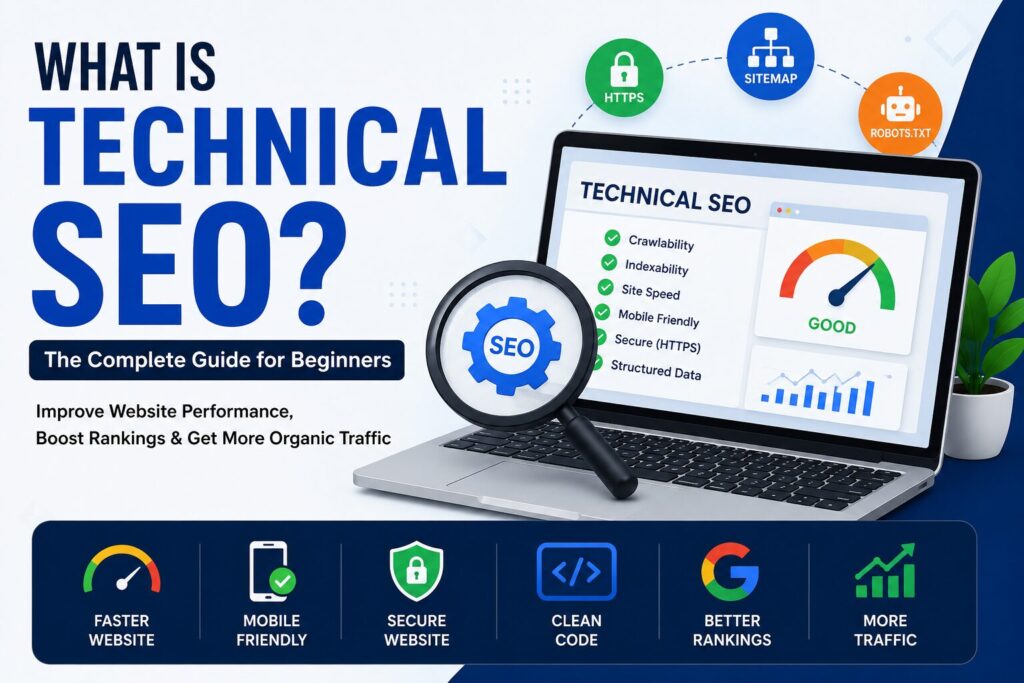
What Is Technical SEO? The Complete Guide to Improving Website Performance in 2026
Have you ever wondered why some websites rank on Google’s first page while others struggle to appear in search results, even with high-quality content? The answer often lies in Technical SEO.
Many website owners spend hours creating blogs, designing beautiful pages, and building backlinks but overlook the technical foundation of their website. If Google cannot properly crawl, index, or understand your website, your chances of ranking decrease significantly.
That’s why understanding What Is Technical SEO is essential for every business, blogger, and digital marketer. Technical SEO ensures that your website is fast, secure, mobile-friendly, and easy for search engines to crawl and index.
In this guide, you’ll learn What Is Technical SEO, why it’s important, its key elements, common mistakes, and best practices to improve your website’s rankings.
What Is Technical SEO?
Technical SEO is the process of optimizing your website’s technical structure so that search engines like Google can easily crawl, index, and understand your content.
Unlike On-Page SEO, which focuses on content and keywords, or Off-Page SEO, which focuses on backlinks, Technical SEO works behind the scenes to improve website performance.
A well-optimized technical foundation helps search engines access every important page efficiently while providing users with a smooth browsing experience.
Why Is Technical SEO Important?
If Google cannot properly access your website, even the best content may never rank.
Technical SEO helps by:
- Improving website crawlability
- Enhancing indexing efficiency
- Increasing website speed
- Boosting user experience
- Supporting higher Google rankings
- Reducing technical errors
- Improving Core Web Vitals
Businesses investing in Technical SEO often experience better organic visibility and long-term SEO performance.
How Does Technical SEO Work?
Understanding What Is Technical SEO becomes easier when you know how search engines process websites.
Google generally follows three main steps:
Crawling
Googlebot visits your website and discovers new pages by following links.
Indexing
After crawling, Google stores eligible pages in its search index.
Ranking
Google evaluates hundreds of ranking signals before deciding where your page should appear in search results.
Technical SEO ensures these three processes happen smoothly.
Key Elements of Technical SEO
Several components make up a successful Technical SEO strategy.
Website Speed
A slow-loading website increases bounce rates and negatively affects user experience.
Improve speed by:
- Compressing images
- Using browser caching
- Enabling GZIP compression
- Using a CDN
- Minimizing CSS and JavaScript files
Faster websites generally perform better in search rankings.
Mobile-Friendly Website
Google uses Mobile-First Indexing, meaning it primarily evaluates the mobile version of your website.
Ensure your website:
- Is responsive
- Loads quickly on mobile devices
- Has readable text
- Uses touch-friendly buttons
- Adapts to different screen sizes
HTTPS Security
Secure websites build trust with users and search engines.
Always install an SSL certificate so your website uses.
XML Sitemap
An XML Sitemap helps Google discover important pages on your website.
A properly configured sitemap improves crawling efficiency, especially for larger websites.
Submit your sitemap through Google Search Console for faster indexing.
Robots.txt File
The Robots.txt file tells search engines which pages they should crawl and which pages should be ignored.
Incorrect Robots.txt settings can accidentally block important pages from Google.
Canonical Tags
Duplicate content confuses search engines.
Canonical tags tell Google which version of a page should be treated as the original.
This helps consolidate ranking signals and prevents duplicate content issues.
Core Web Vitals and Technical SEO
Core Web Vitals are Google’s page experience metrics.
They measure:
- Loading performance
- Visual stability
- User interaction speed
Good Core Web Vitals improve both user experience and search engine rankings.
Regularly monitor these metrics using Google PageSpeed Insights.
Common Technical SEO Issues
Many websites lose rankings because of avoidable technical mistakes.
Common problems include:
- Broken links (404 errors)
- Slow website speed
- Missing XML Sitemap
- Incorrect Robots.txt configuration
- Duplicate content
- Redirect chains
- Missing canonical tags
- Poor mobile usability
- Crawl errors
- Indexing issues
Fixing these issues can significantly improve website performance.
Best Practices for Technical SEO
To build a strong technical foundation, follow these best practices:
Improve Website Speed
Optimize images, reduce unnecessary scripts, and use reliable hosting.
Fix Crawl Errors
Monitor Google Search Console regularly and resolve crawl issues quickly.
Use Structured Data
Schema markup helps search engines better understand your content and may improve search appearance.
Create SEO-Friendly URLs
Keep URLs:
- Short
- Descriptive
- Keyword-focused
- Easy to read
Technical SEO vs On-Page SEO
| Technical SEO | On-Page SEO |
|---|---|
| Website speed | Keyword optimization |
| Crawlability | Content quality |
| XML Sitemap | Heading structure |
| HTTPS | Meta Title |
| Robots.txt | Meta Description |
| Canonical Tags | Internal Linking |
Technical SEO Checklist
Before publishing your website or blog, verify the following:
- Website loads quickly
- HTTPS enabled
- Mobile-friendly design
- XML Sitemap created
- Robots.txt configured
- Canonical tags added
- Broken links fixed
- Image optimization completed
- Structured data implemented
- Google Search Console connected
Following this checklist helps maintain a healthy website.
Why Technical SEO Matters for Business Growth
A technically optimized website provides a better experience for both users and search engines.
Businesses that invest in Technical SEO often experience:
- Better Google rankings
- Increased organic traffic
- Higher conversion rates
- Lower bounce rates
- Faster website performance
- Improved user satisfaction
Whether you operate an eCommerce store, local business, or digital marketing agency, Technical SEO forms the foundation of long-term online success.
Conclusion
Now that you understand What Is Technical SEO, it’s clear that great content alone is not enough to achieve higher Google rankings. Search engines must be able to crawl, index, and understand your website efficiently.
By improving website speed, fixing crawl errors, using HTTPS, optimizing mobile usability, creating XML sitemaps, and monitoring Core Web Vitals, you create a strong technical foundation that supports all your other SEO efforts.
If you want long-term organic growth, investing in Technical SEO is one of the smartest decisions you can make. A technically optimized website not only performs better in search results but also delivers a smoother experience for your visitors.