
What Is Off-Page SEO? The Complete Beginner's Guide to Better Google Rankings
Have you ever wondered why some websites consistently appear on the first page of Google while others struggle to get noticed? The answer often lies beyond the website itself. If you’re asking What Is Off-Page SEO, you’re already taking the first step toward understanding one of the most powerful ranking factors in modern search engine optimization.
Many website owners spend countless hours creating high-quality content and optimizing their web pages but still fail to achieve the rankings they deserve. The missing piece is usually a strong Off-Page SEO strategy.
Simply put, What Is Off-Page SEO? It is the process of improving your website’s authority, trustworthiness, popularity, and reputation through activities that happen outside your own website. These activities help search engines like Google recognize your website as valuable and trustworthy, increasing your chances of ranking higher in search results.
If you want long-term organic traffic, better brand visibility, and higher search engine rankings, understanding What Is Off-Page SEO is essential. In this guide, you’ll learn everything from backlinks to social signals, guest posting, digital PR, and much more.
What Is Off-Page SEO?
What Is Off-Page SEO refers to all the optimization techniques performed outside your website to improve its position on search engine result pages (SERPs). Unlike On-Page SEO, which focuses on optimizing website content, titles, meta descriptions, images, and internal links, Off-Page SEO is all about building your website’s authority across the internet.
Search engines evaluate not only your website but also what other websites and users say about it. When reputable websites link back to your content, Google interprets those backlinks as votes of confidence.
Think of your website as a business. Even if your office is beautifully designed, people will trust it more when others recommend it. That’s exactly how What Is Off-Page SEO works.
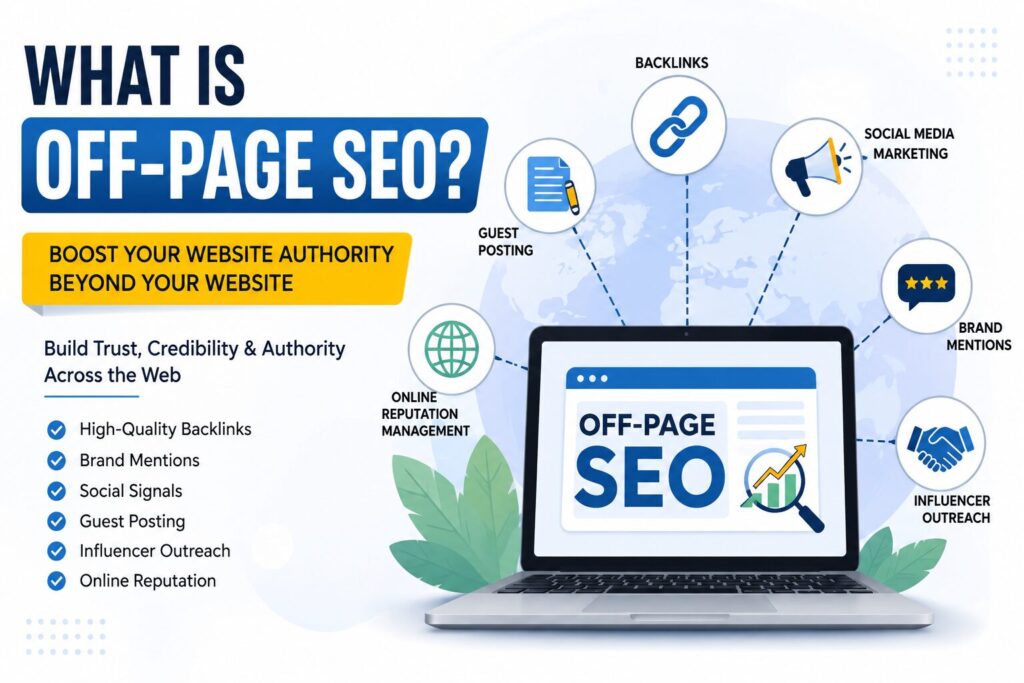
Off-Page SEO includes activities such as:
- Building high-quality backlinks
- Guest posting
- Brand mentions
- Social media promotion
- Influencer outreach
- Digital PR
- Local SEO citations
- Forum participation
- Content marketing
- Online reputation management
Together, these techniques help establish credibility and improve your website’s authority in Google’s eyes.
Why Is Off-Page SEO Important?
Understanding What Is Off-Page SEO is important because Google wants to rank websites that are trustworthy and authoritative.
Imagine two websites publishing the same quality article. One website has hundreds of backlinks from trusted domains, while the other has none. Which website do you think Google will rank higher?
Most likely, the website with stronger authority.
That’s why What Is Off-Page SEO is such an important topic for anyone looking to grow their online presence.
Some major benefits include:
- Improves Google search rankings.
- Builds Domain Authority.
- Increases website credibility.
- Drives referral traffic from other websites.
- Enhances brand awareness.
- Helps search engines trust your content.
- Supports long-term SEO growth.
- Generates more organic leads and sales.
Without Off-Page SEO, even the best content may struggle to compete against established websites.
How Does Off-Page SEO Work?
To fully understand What Is Off-Page SEO, it’s important to know how search engines evaluate websites.
Google uses hundreds of ranking signals, but one of the strongest indicators is how the rest of the internet interacts with your website.
Every quality backlink acts like a recommendation. When authoritative websites mention or link to your content, Google assumes your content is valuable.
For example, if a well-known digital marketing blog links to your SEO article, Google considers that endorsement a positive ranking signal.
Off-Page SEO also measures factors like:
- Website authority
- Link quality
- Brand popularity
- Social engagement
- Online reviews
- User trust
- Content sharing
- Mentions across the web
The stronger these signals become, the higher your chances of ranking on Google’s first page.
Top Off-Page SEO Techniques That Actually Work
Knowing What Is Off-Page SEO is only the beginning. Applying the right strategies is what delivers results.
Here are some of the most effective techniques used by SEO professionals worldwide:
1. High-Quality Backlinks
Backlinks remain the backbone of Off-Page SEO.
A backlink is simply a hyperlink from another website pointing to your website. High-quality backlinks from authoritative websites significantly improve rankings.
Focus on earning backlinks naturally through valuable content instead of buying links, as Google may penalize websites that use manipulative link-building practices.
2. Guest Posting
Guest posting involves writing articles for other reputable websites in your niche.
It helps you:
- Earn quality backlinks.
- Reach new audiences.
- Increase brand authority.
- Build relationships within your industry.
When done correctly, guest posting is one of the safest and most effective Off-Page SEO strategies.
3. Social Media Marketing
Although social signals are not a direct ranking factor, social media helps your content gain visibility, attract visitors, and earn natural backlinks.
Sharing your content consistently on platforms like Facebook, LinkedIn, Instagram, X, and Pinterest increases the chances of your content being discovered and referenced by other websites.
This indirectly strengthens your Off-Page SEO efforts.
More Effective Off-Page SEO Techniques
Off-Page SEO is much more than building backlinks. If you truly understand What Is Off-Page SEO, you’ll know that Google’s algorithm evaluates multiple trust signals before deciding where your website should rank. The following techniques can strengthen your website’s authority and improve long-term organic visibility.
4. Brand Mentions
Google doesn’t only pay attention to backlinks. It also recognizes brand mentions, where your business or website is referenced online without a clickable link.
The more people talk about your brand on blogs, news websites, forums, and social media, the more trustworthy your website appears. Consistent brand mentions help improve online authority and support your overall Off-Page SEO strategy.
5. Digital PR
Digital PR involves creating newsworthy content that journalists, bloggers, and media websites want to publish. A successful Digital PR campaign can earn high-authority backlinks from trusted publications.
Examples include:
- Original research
- Industry reports
- Surveys
- Infographics
- Press releases
- Expert opinions
These backlinks are highly valuable because they come from reputable sources.
6. Influencer Outreach
Collaborating with influencers in your industry can expose your website to a larger audience. When influencers mention your website or share your content, it increases brand awareness and may generate natural backlinks from other websites.
7. Local SEO Citations
If you own a local business, citations play an important role in Off-Page SEO. List your business on trusted directories and ensure that your Name, Address, and Phone Number (NAP) remain consistent across every platform.
Popular places to create citations include:
- Google Business Profile
- Bing Places
- Yelp
- Justdial
- IndiaMART
- Sulekha
Consistent citations improve local search visibility and build trust with search engines.
8. Forum Participation
Participating in niche-related forums allows you to answer questions and share helpful information. Focus on adding value rather than promoting your website excessively.
Useful forums include:
- Quora
- Industry-specific communities
Thoughtful participation can drive referral traffic and improve your online reputation.
9. Content Marketing
Creating valuable content is one of the best ways to attract natural backlinks. Publish content that people genuinely want to reference, such as:
- Ultimate guides
- Case studies
- Original research
- Statistics
- Checklists
- Free tools
- Templates
High-quality content naturally earns links over time, making it one of the safest and most effective Off-Page SEO techniques.
Benefits of Off-Page SEO
Now that you understand What Is Off-Page SEO, let’s explore its biggest advantages.
A strong Off-Page SEO strategy can:
- Improve Google rankings.
- Increase Domain Authority.
- Build trust and credibility.
- Drive referral traffic.
- Generate qualified leads.
- Increase brand awareness.
- Improve indexing speed.
- Support long-term organic growth.
- Help your website compete with larger competitors.
- Increase conversions through better visibility.
The stronger your online reputation becomes, the easier it is to rank for competitive keywords.
Common Off-Page SEO Mistakes to Avoid
Many website owners make mistakes that can negatively affect rankings. Avoid these common errors:
- Buying low-quality backlinks.
- Participating in link farms.
- Overusing exact-match anchor text.
- Ignoring brand mentions.
- Creating spammy directory links.
- Posting duplicate guest articles.
- Neglecting social media promotion.
- Building links from irrelevant websites.
- Using automated link-building software.
Google rewards websites that earn links naturally through valuable content and genuine relationships.
Best Practices for Off-Page SEO
To achieve sustainable results, follow these proven best practices:
- Focus on quality instead of quantity when building backlinks.
- Publish helpful, original, and in-depth content.
- Build relationships with bloggers and industry experts.
- Promote every new blog on social media.
- Monitor your backlink profile regularly.
- Remove or disavow harmful backlinks if necessary.
- Earn links naturally through valuable resources.
- Keep your brand active across multiple online platforms.
Consistent effort always delivers better results than shortcuts.
Conclusion
If you’ve been wondering What Is Off-Page SEO, the answer is clear: it’s the process of building your website’s authority, credibility, and reputation beyond your own pages. While On-Page SEO ensures your website is technically optimized and user-friendly, Off-Page SEO helps search engines trust your content through backlinks, brand mentions, social engagement, digital PR, and other external signals.
A successful SEO strategy combines both On-Page and Off-Page SEO. Instead of chasing quick results or spammy tactics, focus on creating valuable content, earning high-quality backlinks, engaging with your audience, and building genuine relationships within your industry.
By consistently applying the techniques covered in this guide, you’ll strengthen your website’s authority, improve search engine rankings, attract more organic traffic, and create sustainable long-term growth.
Start implementing these Off-Page SEO strategies today, and you’ll be well on your way to achieving higher Google rankings and greater online success.