
Role of Artificial Intelligence in Marketing and Business Growth
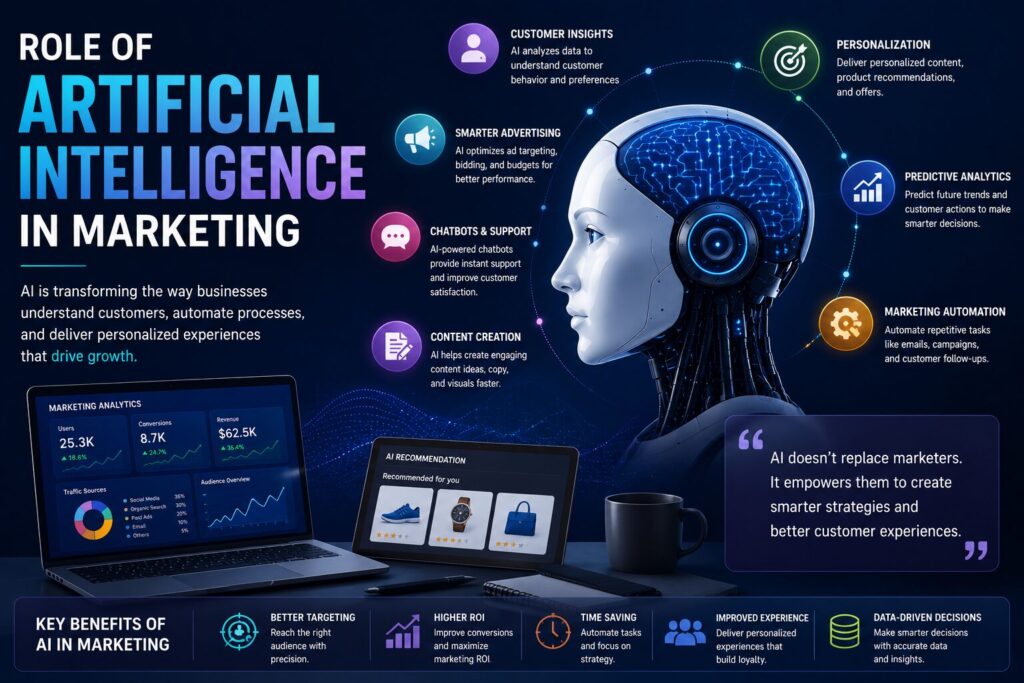
Table of Contents
Role of Artificial Intelligence in Marketing – How AI Is Revolutionizing Digital Marketing in 2026
Introduction to the Role of Artificial Intelligence in Marketing
The role of artificial intelligence in marketing is growing faster than ever before. Businesses today are no longer relying only on traditional marketing methods because customer behavior has changed completely in the digital age. People now expect personalized experiences, instant responses, smart recommendations, and highly relevant content whenever they interact with a brand online. This is why the role of artificial intelligence in marketing has become extremely important for businesses that want to stay ahead of competitors and achieve long-term success.
Artificial Intelligence, commonly known as AI, is helping companies automate marketing processes, analyze customer behavior, improve advertising performance, and create personalized customer experiences. From Google search results and social media advertising to email marketing and chatbots, AI technologies are now involved in almost every area of digital marketing. Businesses that use AI-powered marketing strategies are able to save time, reduce costs, improve targeting, and increase conversions more effectively.
Today, companies across industries such as healthcare, eCommerce, education, finance, real estate, travel, and technology are investing heavily in AI-driven marketing tools. The increasing demand for smarter and more data-driven marketing solutions is one of the biggest reasons why the role of artificial intelligence in marketing is becoming more powerful every year.
What Is Artificial Intelligence in Marketing?
Artificial Intelligence in marketing refers to the use of machine learning, automation tools, predictive analytics, and data-driven technologies to improve marketing strategies and customer engagement. The role of artificial intelligence in marketing focuses on helping businesses understand customer behavior, automate repetitive tasks, and deliver personalized experiences through digital platforms.
AI systems can collect and analyze huge amounts of customer data in real time. This data includes browsing history, purchasing behavior, search patterns, engagement activity, and online interests. Businesses use this information to create targeted marketing campaigns and improve customer communication.
Unlike traditional marketing methods, AI-driven marketing allows businesses to make smarter decisions based on real-time insights. This helps marketers optimize campaigns faster and improve overall business performance. As digital competition increases, the role of artificial intelligence in marketing is becoming essential for modern business growth.
Why the Role of Artificial Intelligence in Marketing Is Increasing Rapidly
The role of artificial intelligence in marketing is increasing rapidly because businesses want faster, smarter, and more efficient marketing solutions. Traditional marketing strategies often require significant manual work and data analysis, but AI technologies automate these processes and improve accuracy.
One major reason behind the growth of AI marketing is personalization. Modern customers expect brands to understand their preferences and deliver relevant recommendations. AI tools analyze customer interests and online behavior to provide personalized advertisements, emails, and product suggestions.
Automation is another important reason why the role of artificial intelligence in marketing is growing. Businesses can automate email campaigns, social media scheduling, customer responses, ad optimization, and lead nurturing using AI-powered systems. This saves time while improving productivity and marketing efficiency.
Another reason is the rise of big data. Businesses now collect massive amounts of customer data through websites, mobile apps, and digital platforms. AI technologies help marketers process and analyze this data quickly to make informed marketing decisions.
Role of Artificial Intelligence in Digital Advertising
AI Improves Ad Targeting and Audience Segmentation
One of the most important aspects of the role of artificial intelligence in marketing is audience targeting. AI helps businesses identify potential customers based on demographics, online behavior, search intent, interests, and purchasing patterns.
Platforms like Google Ads and Facebook Ads use AI algorithms to optimize audience targeting automatically. AI systems analyze user data and predict which audience groups are most likely to engage with advertisements and convert into customers.
This advanced targeting improves ad performance, reduces advertising waste, and increases return on investment. Businesses using AI-powered advertising strategies often achieve better results compared to traditional advertising methods.
AI Helps Optimize Advertising Campaigns
The role of artificial intelligence in marketing also includes campaign optimization. AI technologies continuously monitor campaign performance and make real-time adjustments to improve results.
AI tools optimize bidding strategies, ad placements, audience targeting, and budget allocation automatically. This allows businesses to maximize conversions while reducing advertising costs. AI-driven optimization helps companies improve click-through rates and lead generation more effectively.
Modern digital advertising platforms depend heavily on artificial intelligence because AI improves campaign performance through continuous learning and automation.
Role of Artificial Intelligence in SEO and Content Marketing
AI Improves Search Engine Optimization Strategies
Search Engine Optimization has evolved significantly because of the growing role of artificial intelligence in marketing. AI-powered SEO tools help marketers analyze keywords, identify search trends, understand user intent, and optimize website content according to Google algorithms.
AI systems can recommend high-ranking keywords, improve content readability, and identify SEO opportunities faster than manual research methods. Businesses use AI tools to optimize blog articles, landing pages, meta descriptions, and website structure for better search engine rankings.
Google itself uses artificial intelligence in search algorithms to understand user queries and deliver more relevant search results. This means businesses must create valuable, user-focused, and SEO-optimized content to rank successfully.
AI Helps Create Personalized Content
Content marketing is another area where the role of artificial intelligence in marketing is highly visible. AI tools analyze customer preferences and recommend content topics that are more likely to engage audiences.
Businesses now use AI-powered systems to create personalized blog recommendations, email content, social media captions, and website experiences. Personalized content improves customer engagement because users receive information that matches their interests and needs.
AI also helps marketers understand which content performs best by analyzing user engagement metrics such as click rates, reading time, and conversion data.
Role of Artificial Intelligence in Email Marketing
The role of artificial intelligence in marketing has completely transformed email marketing strategies. AI tools help businesses create highly personalized email campaigns based on customer behavior and engagement history.
AI analyzes open rates, click-through rates, browsing behavior, and purchase patterns to send relevant emails at the right time. Personalized email marketing improves engagement and increases conversion rates significantly.
Businesses also use AI to automate email sequences such as welcome emails, follow-up emails, abandoned cart reminders, and promotional campaigns. This automation saves time while improving customer communication and retention.
AI-driven email marketing helps businesses deliver better customer experiences through highly relevant and personalized messaging strategies.
Role of Artificial Intelligence in Social Media Marketing
Social media marketing has become more advanced because of the growing role of artificial intelligence in marketing. AI tools help businesses analyze audience behavior, identify trending topics, and improve content performance across social media platforms.
AI-powered systems can recommend the best posting times, analyze engagement patterns, and optimize social media advertisements automatically. Businesses use AI to improve brand visibility, customer interaction, and social media campaign performance.
Chatbots powered by artificial intelligence are also widely used on platforms like Facebook Messenger and Instagram to provide instant customer support and improve user engagement.
The increasing use of AI in social media marketing is helping brands build stronger relationships with customers and improve overall digital presence.
Role of Artificial Intelligence in Customer Experience
AI Chatbots Improve Customer Support
Customer service has changed significantly because of the role of artificial intelligence in marketing. AI chatbots provide instant responses to customer queries and improve customer satisfaction.
Businesses use chatbots on websites, mobile apps, WhatsApp, and social media platforms to answer frequently asked questions, guide users, and assist with purchases. AI-powered customer support systems work 24/7, which improves response speed and user experience.
AI chatbots also reduce operational workload for businesses while improving customer interaction and engagement.
Predictive Analytics Helps Understand Customer Behavior
The role of artificial intelligence in marketing also includes predictive analytics. AI systems analyze customer behavior and predict future actions based on historical data.
Predictive analytics helps businesses identify which customers are likely to purchase products, unsubscribe from services, or engage with specific marketing campaigns. This allows marketers to create smarter marketing strategies and improve customer retention.
Businesses using predictive analytics can make data-driven decisions that improve marketing efficiency and long-term business growth.
Benefits of the Role of Artificial Intelligence in Marketing
The role of artificial intelligence in marketing provides multiple benefits for businesses. AI improves marketing efficiency, increases automation, enhances personalization, and reduces manual work significantly.
AI technologies also improve audience targeting and campaign optimization. Businesses can reach highly relevant customers while minimizing advertising costs and improving conversion rates.
Another major advantage is scalability. AI-powered systems can handle large amounts of customer data and automate complex marketing tasks without increasing operational workload.
The growing role of artificial intelligence in marketing is also helping businesses achieve better customer engagement and stronger brand loyalty through personalized digital experiences.
Challenges of Artificial Intelligence in Marketing
Although the role of artificial intelligence in marketing offers many benefits, businesses also face certain challenges while implementing AI technologies.
One major challenge is data privacy and security. Businesses must ensure that customer data is collected and used responsibly according to privacy laws and regulations.
Another challenge is the cost of advanced AI tools and software. Small businesses may initially struggle to invest in high-quality AI-powered marketing systems.
AI technologies also require skilled professionals who understand how to use automation tools, analyze data, and manage AI-driven marketing campaigns effectively.
Despite these challenges, the future of AI marketing remains highly promising because technology continues evolving rapidly.
Future of the Role of Artificial Intelligence in Marketing
The future role of artificial intelligence in marketing is expected to become even more advanced in the coming years. AI technologies will continue improving personalization, automation, predictive analytics, and customer engagement.
Voice search optimization, AI-generated content, machine learning, and virtual assistants will play a major role in future marketing strategies. Businesses that adopt AI-powered marketing solutions early will have a strong competitive advantage in the digital marketplace.
The integration of AI with social media platforms, eCommerce systems, and customer relationship management software will create smarter and more personalized customer experiences worldwide.
As online competition continues increasing, the role of artificial intelligence in marketing will become even more important for businesses that want sustainable growth and stronger digital presence.